
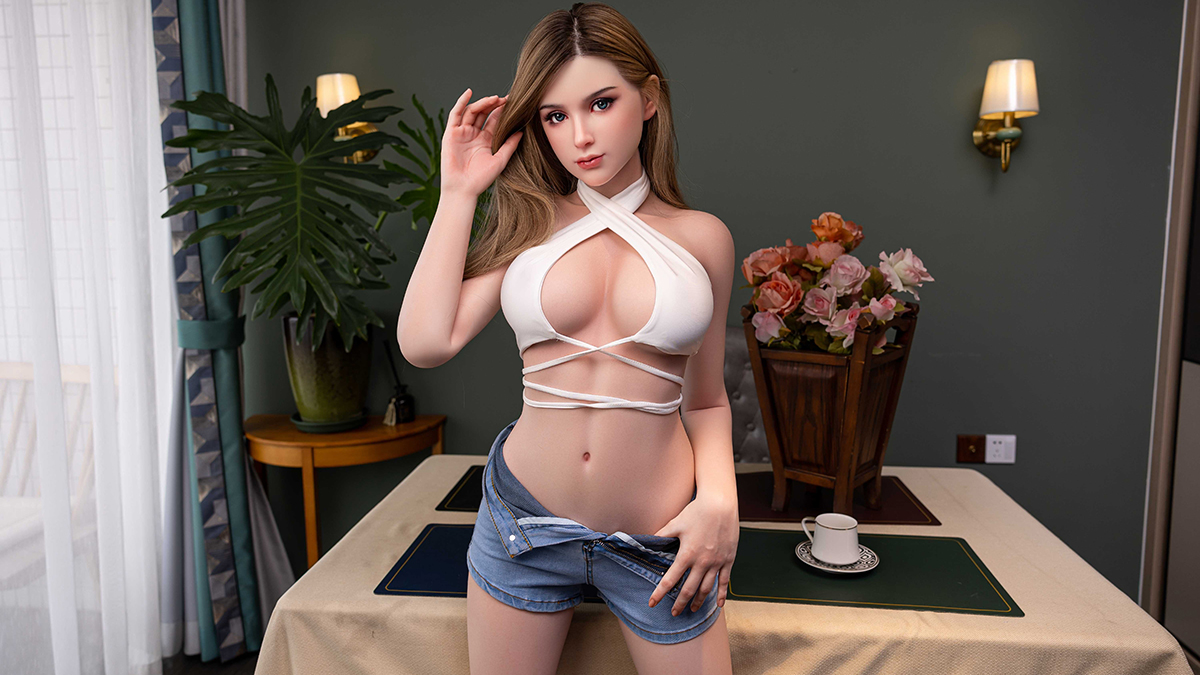
Proportion Is How the Brain Recognizes Realism
realistic doll proportion is not a technical detail—it is the mechanism through which the brain decides whether something feels human. Most people assume realism comes from surface elements: skin texture, facial detail, height, or specific measurements. But perception does not begin with measurement. It begins with relational mapping.
The human visual system processes bodies holistically. It reads how the head relates to the shoulders, how the torso transitions into the hips, how limb length balances with overall posture. These ratios form a structural rhythm. When that rhythm aligns with our lived experience of human anatomy, the brain relaxes. When it does not, subtle cognitive friction appears. The object may look impressive, but it does not fully settle into perception.
This happens because the brain builds proportional expectations from real-world exposure. Every person we see contributes to an internal template of what “balanced” looks like. That template is not mathematical—it is intuitive. When an artificial form matches those relational cues, it passes smoothly through recognition. When the cues conflict, the brain keeps re-checking what it sees.
Size alone does not correct imbalance. Enlarging a distorted structure simply magnifies distortion. Shrinking it does not fix it either. Only restoring relational harmony resolves the tension. This is why proportion matters more than scale in determining realism. A well-balanced form at any size can feel authentic. A poorly balanced form at any size feels stylized or exaggerated.
In sculpture and classical anatomy studies, proportion has always taken priority over measurement. Artists study ratios long before they focus on magnitude. They understand that realism is less about “how big” and more about “how aligned.” The same principle applies here. Realism is recognized through structural coherence.
When evaluating realism, the better question is not “How tall is it?” but “Does everything relate naturally?” That shift—from dimension to relationship—changes the entire framework of judgment. Realism is not declared by numbers. It is confirmed by proportional harmony.
Why Larger Scale Often Creates Short-Term Impact but Not Long-Term Comfort
It is easy to equate size with presence. Larger forms occupy more visual space, command attention immediately, and create a stronger first impression. In early evaluation stages, this impact can feel convincing. The object appears substantial. It feels noticeable. However, visual impact and long-term realism are not the same experience. One is immediate stimulation. The other is sustained psychological comfort.
When scale increases without proportional discipline, small relational imbalances become more visible. A slightly elongated torso, marginally oversized limbs, or disproportionate curvature may not seem obvious at first glance. But over time, the brain repeatedly registers these inconsistencies. The form never fully integrates into natural perception. Instead of fading into familiarity, it remains visually “active.”
This ongoing visual activity creates subtle cognitive fatigue. The viewer may not consciously identify what feels different, but the mind continues to compare the form against its internal template of human structure. The mismatch does not produce dramatic dissatisfaction. It produces mild but persistent awareness. The object feels staged rather than naturally present.
In contrast, proportionally balanced forms tend to become visually quiet. After the initial observation, the brain stops re-evaluating. Nothing demands correction. Nothing interrupts spatial comfort. This quietness is often mistaken for simplicity, but it is actually structural coherence. When alignment is correct, perception stabilizes.
Larger scale is not inherently unrealistic. When relational ratios are preserved, scale can coexist with authenticity. The issue arises when size becomes the primary driver of design decisions and proportion becomes secondary. Magnification amplifies everything—including imbalance. What might be subtle at smaller dimensions becomes more apparent as scale increases.
Over longer periods of exposure, many individuals discover that realism is less about how imposing something feels and more about how naturally it occupies space. Comfort emerges not from dominance but from harmony. This is why short-term visual impact should not be confused with long-term aesthetic satisfaction. Impact excites attention. Proportion sustains belief.

Why Smaller Frames Often Achieve Stronger Perceived Realism
Smaller frames are often overlooked in discussions about realism because attention tends to gravitate toward scale. Yet in many cases, compact dimensions make proportional accuracy more visible—and therefore more carefully executed. When overall size is reduced, the margin for anatomical inconsistency narrows. Designers cannot rely on visual dominance to compensate for imbalance. Structural harmony becomes essential.
In smaller forms, every relational decision carries greater weight. The head must sit naturally within shoulder width. Limb length must align convincingly with torso depth. Hip placement must support believable posture. Because the frame is compact, even slight exaggerations appear more pronounced. This pressure toward accuracy often results in stronger proportional discipline.
Psychologically, smaller proportionally balanced forms also interact differently with space. They do not overwhelm their surroundings. Instead, they integrate into them. This integration creates a sense of natural presence rather than staged display. The experience becomes grounded. The object feels situated rather than showcased.
Another factor is visual settling. When proportions are harmonious within a smaller frame, the eye quickly accepts the structure and moves on. There is less visual scanning, less subconscious correction. The form becomes familiar more quickly. Familiarity reinforces realism because the brain stops testing the structure against its internal reference patterns.
This does not mean smaller automatically equals more realistic. Poor proportion at any size reduces authenticity. However, when proportional coherence is prioritized, compact dimensions often enhance the perception of unity. The figure appears complete rather than exaggerated. Nothing feels added for effect. Nothing competes for attention.
Design philosophies centered on anatomical balance can often be observed most clearly in collections built around compact structure. For example, proportion-focused sculpting principles are evident within the Small Frame Silicone category, where scale remains secondary to relational harmony. The emphasis is not on minimizing size, but on preserving structural alignment.
When internal ratios align naturally, realism becomes quiet and stable. Smaller frames can make this alignment more apparent. The result is not reduced presence—but refined coherence.
When Proportion May Not Be the Primary Priority
While proportion plays a central role in realism, realism itself is not always the primary objective. Different aesthetic goals demand different evaluative frameworks. In some cases, stylization, exaggeration, or symbolic expression takes precedence over anatomical accuracy. When this is the intention, proportional deviation is not a flaw but a design choice.
Exaggerated proportions are common in character design, fantasy representation, and artistic abstraction. These forms are not attempting to replicate natural human presence. Instead, they communicate identity, emotion, or narrative. In such contexts, realism is secondary to expression. Expecting proportional accuracy in these designs would misunderstand their purpose.
Problems arise when expectation and intention are misaligned. If a viewer seeks natural presence but evaluates primarily through size or dramatic impact, the resulting experience may feel unsatisfying. The issue is not poor execution, but a mismatch between aesthetic philosophy and personal goal.
Understanding this distinction reduces unnecessary decision anxiety. Rather than asking which design is objectively better, the more useful question becomes: what experience am I seeking? If the goal is realism that integrates quietly into daily perception, proportion becomes critical. If the goal is visual emphasis or fantasy presence, proportion may play a supporting rather than central role.
This is why realistic doll proportion matters most in realism-oriented contexts. It defines whether the form settles into natural familiarity or remains visually performative. In other contexts, different rules apply. Neither approach is universally superior.
Clarity of intent transforms evaluation. When purpose is understood, proportion becomes either a foundational criterion or a flexible parameter. Confusion occurs only when these frameworks are mixed. Alignment, not persuasion, determines satisfaction.

Aesthetic Philosophy: Balance Over Specification
realistic doll proportion ultimately reflects a broader aesthetic philosophy: realism is not achieved by accumulation, but by alignment. Measurements describe scale, but relationships define believability. When proportional structure is coherent, perception stabilizes. The brain stops searching for inconsistencies. The form feels complete rather than constructed.
This perspective reframes how realism should be evaluated. Instead of comparing specifications, attention shifts to experience. Experience unfolds gradually—through repeated exposure, spatial interaction, and emotional familiarity. Proportion determines whether that experience becomes comfortable or demanding over time. Numbers can be impressive, but they cannot guarantee perceptual ease.
Focusing on proportion also reduces comparison anxiety. When size becomes the primary metric, evaluation often turns competitive. Larger appears better. More appears superior. Proportional thinking disrupts this pattern. It encourages assessment based on coherence rather than magnitude. The question becomes whether the form feels internally consistent, not whether it exceeds a numerical threshold.
This philosophy does not argue against size. Scale remains a neutral variable. What gives scale meaning is structure. A larger form can feel natural if relationships remain intact. A smaller form can feel artificial if they do not. Proportion is the constant that governs realism across all dimensions.
Over time, proportionally balanced forms tend to generate quiet confidence rather than persistent stimulation. They do not rely on exaggerated presence to maintain interest. Their realism sustains itself through structural harmony. This makes them particularly suited for long-term ownership rather than short-term novelty.
Ultimately, proportion is not a minor design attribute. It is the foundation upon which aesthetic credibility rests. Size may capture attention, but proportion determines whether belief endures. When balance is prioritized over specification, realism becomes less about what is seen—and more about what no longer needs to be questioned.

